Imagine it's a Tuesday morning, you open your laptop, log in to your workspace, and realize you have a ton of work to do. There are five new vendor companies to onboard. For each, you will need to request historical data, create a customized compliance contract depending on the state they are in, check their financials against your own in your accounting software, send the email, and update your CRM with any paperwork signed.
Some time ago, you would have opened ChatGPT or your favorite AI assistant and asked it to give you a prompt for a vendor compliance contract. The AI would have been helpful, spitting out text that you would have copied, pasted, and sent. You would have tracked the documents, sent them out, and done everything else. But this time, instead of asking the AI to give you a contract, you type in one sentence:
"Please onboard the five new vendors from yesterday's pipeline."
You wait while your coffee brews and go back to your desk after thirty minutes. The AI has found the five companies, generated the documents, sent the emails (from your outlook account), created a tracking system, and summarized the documents (leaving a notification on your screen) with two having signed and three remaining unsigned. It did not ask for help, and it managed to navigate through four unrelated pieces of software to do it. This is the world of Agentic AI, and we are getting there.
We are witnessing a paradigm transfer in technology. The shift from an economy of AI assistants to AI workers. This article unpacks what that means and how we, as humans, can prepare for it.
What Exactly Is Agentic AI?
To understand what Agentic AI is, you need to first know what it is NOT. Until recently, the dominant form of AI in the space was simply chatbots (think of your friendly neighborhood ChatGPT). These are AI models that perform tasks when prompted. They follow a simple transactional model of Input -> Output. Once they complete their task, their job is done. They have no concept of the passage of time or independent action. If you ask a chatbot to write an essay, it cannot save it and come back to it later. Unless told explicitly to continue writing, it will finish the essay and be done. They can do nothing beyond answering prompts and therefore have extremely limited utility.
An agentic system is different. An "AI Agent" is an AI system that is given a high-level directive rather than a specific prompt. Put another way,
If Generative AI is a superstar assistant always waiting for your orders, Agentic AI is a remote employee that takes on projects, executes on them, and only reports back when it has completed its task.
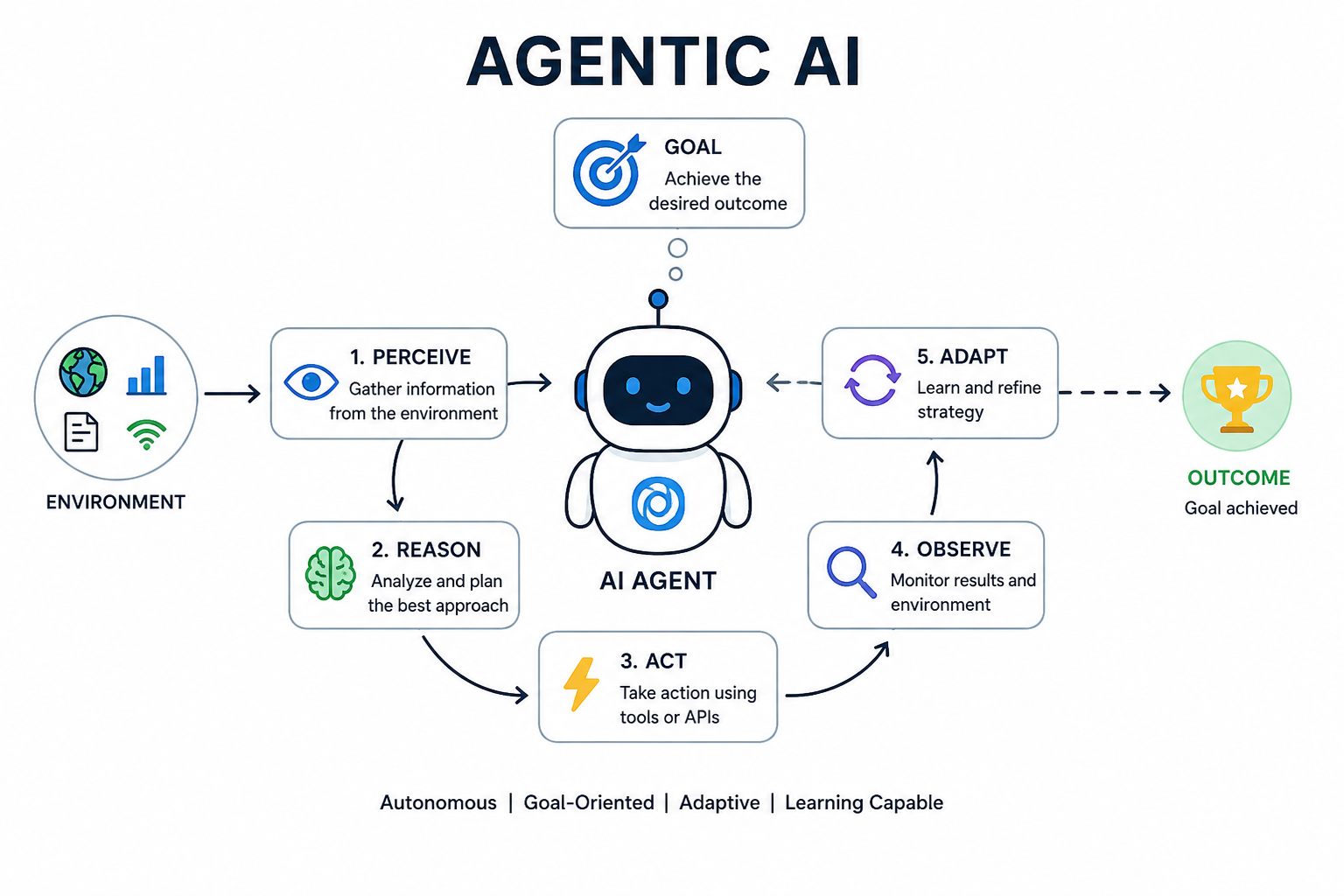
Like any good employee, an AI agent can look around a room, understand what needs to be done, use any tools it needs to get the job done, and correct itself when it makes a mistake. Now let's take a closer look at how exactly these systems work.
The Four Pillars of Agentic Architecture
How does an AI agent perform tasks when prompted? How can it navigate external software? It turns out there are four pillars that make up agentic architecture.
1. Reasoning and Planning
Most large language models today are really good at one thing: answering questions. This makes sense, as that is the basic prompt you give them when you use them. However, when you ask an AI agent to execute on a goal, it will break it into smaller, executable mini-goals using reasoning. For example, if I asked it to publish a comprehensive market report, it would generate a dynamic checklist of steps to complete this task. Step 1: Find the latest data on the market. Step 2: Remove all spammy links from the list of potential sources. Step 3: Create a table with the relevant statistics. Step 4: Write the report and so on.
2. Tool Use (The Execution Engine)
This is where things get interesting. Most chatbots can barely navigate your website. AI agents, on the other hand, are given "hands" through which they can interact with other computer systems. These can range from simple APIs to emulate a human typing into a web form to more complex applications like Python code execution or a fully developed browser that can click through websites, extract data from PDFs, or even run Slack commands.
3. Memory
An agent has a certain degree of context awareness, meaning it can keep track of what it is doing. Most agents are given a "short-term memory" (usually implemented as a chat log) to keep track of their current task. More advanced agents use separate databases to store their long-term memory, allowing them to keep track of their personal preferences or specific rules defined for their task.
4. Reflection and Self-Correction
When a chatbot encounters an error, it usually gets stuck or "hallucinates,", i. e., makes up information. An Agent, on the other hand, has some degree of self-awareness and can modify its approach if a particular step in its process is not working. For example, if the agent encounters a website that refuses to load, it can try a different URL instead. Similarly, if it encounters an error when writing code, it can read the error message, edit the code, and re-run it until it produces the desired result before presenting it to the user.
From Theory to Practice: How Are Agents Used Today?
Agentic AI systems are not a distant fantasy; they are already being used in the present and revolutionizing the way we work. Some of the most common use cases include:
Software Engineers and DevOps Agents
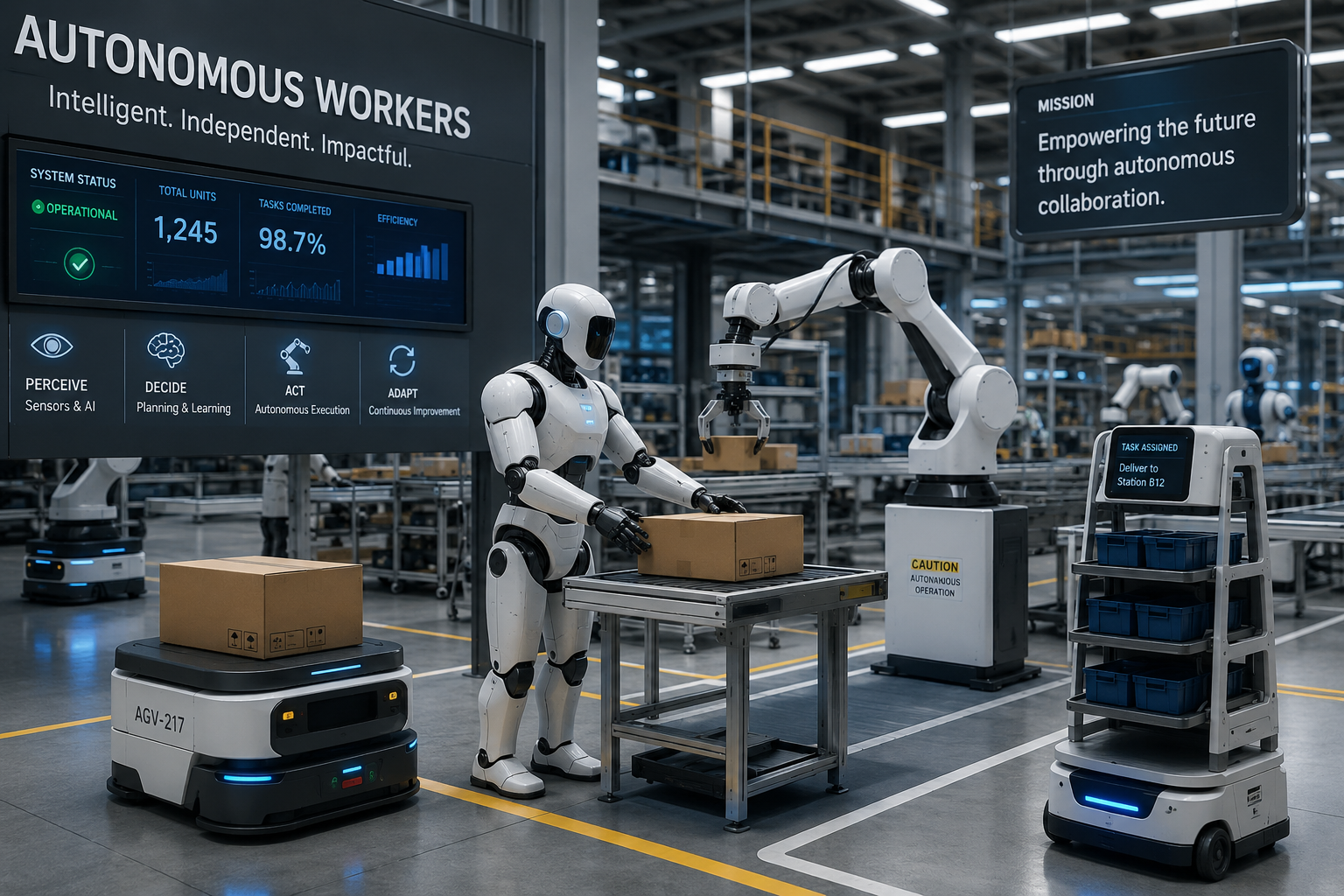
Modern software developers and operations engineers are already using agentic AI systems to automate their day-to-day tasks. An agent can be tasked with "fixing the bug reported in GitHub issue #5678". It will then clone the repository, search through hundreds or thousands of lines of code to find the error, write a patch, spin up a local server to test it and make sure nothing else breaks, and submit the changes for review. It is important to note that while AI agents are often compared to humans, they are much more powerful than humans when working with computers.
Enterprise Management and Multi-Agent Networks
An agent can be much more than an autopilot for your coding or word processing needs. When multiple agents are networked together, they can perform complex tasks that would be impossible for a single agent to achieve alone. For example, a Supply Chain Agent may realize that the inventory for a particular product is running low and alert a Procurement Agent, who will find the best deal on the market. The Procurement Agent will then forward its findings to a Finance Agent, which will examine the company's financials to see if this purchase is viable and, if so, approve the purchase automatically.
Browser Automation and Agentic Commerce
One exciting innovation in the field is the development of agentic browsers. These are applications that allow agents to access the internet, mimicking a human's ability to move around on websites. These agents can perform tasks that previously required complex manual processes, such as extracting data from websites that have not been optimized for automation. Agentic commerce is also a growing field, where agents can be given "tokens" as a safe way to spend money on goods and services on your behalf.
Why This Shift Matters: Changing the Way We Work
The implications of this shift from traditional AI assistants to autonomous workers are significant. They touch on fundamental economic and philosophical questions about how we want to live our lives. Until now, most software innovations have focused on helping us work faster or become better at our jobs. We have been the bottleneck in the system. All software we use requires people to move information from one place to another, from copying and pasting Excel spreadsheets into web forms to taking notes during meetings and typing them into our calendar. Agentic AI promises to change that.
Agentic AI acts as a co-pilot, reducing the friction and overhead associated with working in the digital world. It enables us to focus more on higher-level strategic initiatives and less on day-to-day drudgery. For example, a marketing analyst can analyze customer data to identify trends that human teams can act on, rather than spending time entering or manipulating data sets.
Human-in-the-Loop: Moving from Doers to Managers
When reading about the capabilities of agentic AI, one might ask, "What is the point of any of this?" If an AI assistant can think, plan, use external tools, and even correct its mistakes, isn't the human worker completely superfluous? Not quite. In many ways, human workers are not being replaced but transformed. This concept is sometimes referred to as Human-in-the-Loop (HITL). The idea is that instead of acting as an end-user of technology, humans can manage, refine, and improve digital agents. This HITL paradigm has several key themes:
Goal Setting and Guardrails
AI agents need to have clear goals defined for them by humans. This could range from simple instructions like "send me an email every time there is a new support ticket" to complex directives like "create a financial report based on my company's performance over the last quarter".
Exception Management, Reviews, and Approvals
While AI agents can complete many complex tasks, humans still need to intervene at critical points to ensure nothing goes wrong. For example, an agent might be able to prepare a contract or a financial audit, but a human likely needs to review the final document before sending it out.
Edge Case Management
Sometimes, an agent may encounter a situation or error that it is not prepared to handle. In these cases, the agent should be programmed to stop and ask for human help.
At a certain level, your job description is shifting from "doer" to "manager" of a team of agents. These digital co-workers can complete tasks faster and more efficiently than ever before, increasing your overall productivity.
The Roadblocks: Safety, Security, and Trust
In the real world, the road to autonomous AI workers is littered with roadblocks. This is because many of the things mentioned above are extremely difficult technical problems. A few important considerations include:
Securing The System Against Threats: Prompt Injection and Leaks
Any agent that has access to your emails, finances, and other systems is a potential attack surface. Bad actors might be able to exploit it through "prompt injection", tricking the agent into doing things it should not do. This could range from stealing your private data to emptying your bank account.
Avoiding Runaway Actions and Infinite Loops
Sometimes, an agent can misunderstand what you want it to do and get stuck doing it repeatedly. This could mean "accidentally" sending thousands of client emails or spending thousands of dollars in cloud computing costs trying to complete a calculation.
Traceability, Logging, Auditing
Because agents often operate as self-contained systems, making sure that humans can follow their decision-making process is important. For example, if a company asks its agent to approve a purchase, it needs to be able to see, step-by-step, why the agent made that choice.
Conclusion: Embracing An Agentic Future
The shift from AI assistants to AI workers represents a paradigm shift in technology. We are moving from a world of static websites and apps to self-driving, problem-solving systems. In the process, we are witnessing the rise of new fields like generative AI, which has already begun to reshape the world. This is both exciting and intimidating, as we must rethink how to position ourselves in this new economy.
To thrive in this world, you must start preparing today. Think about your work in terms of "processes" rather than actions. Think creatively, and you will realize that almost any repetitive task could be automated. Your objective should be to identify which of these processes you can delegate to an AI agent. The future belongs to those who embrace this change and adapt their skills accordingly.

💬 Discussion (0)
No comments yet. Be the first to share your thoughts!
Leave a Response