
For generations, personal finance advice has remained virtually unchanged. We have been told to track every cup of coffee, manually input numbers into complex spreadsheets, and spend Sunday afternoons balancing checkbooks or categorizing transactions. It was a system built on sheer willpower, tedious manual labor, and constant financial anxiety.
But human willpower is a finite resource. Life gets busy, spreadsheets get neglected, and the gap between knowing what we should do with our money and what we actually do remains frustratingly wide.
Today, a massive shift is occurring. Artificial intelligence is quietly dismantling the old, painful rules of personal finance and replacing them with a system that is automated, highly personalized, and predictive. AI is transforming money management from a stressful chore into an effortless, background utility.
Here is how AI is rewriting the rules of the game and how you can use it to journey from basic budgeting to true wealth creation.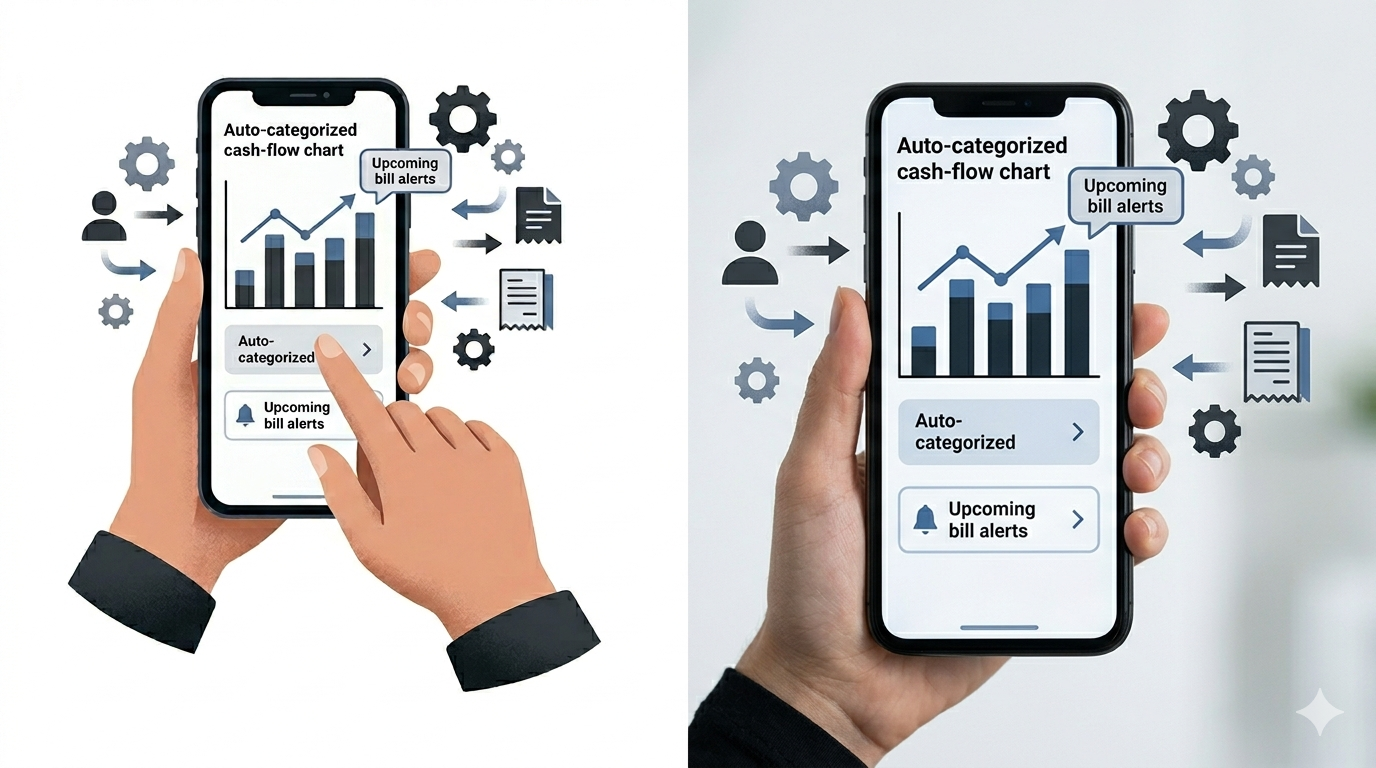
The Death of the Traditional Budget
The old rule of personal finance was rigid: Create a strict budget at the start of the month, track every penny, and feel guilty when you inevitably overspend in a category.
Traditional budgeting fails because it is reactive. You look at a statement at the end of the month, realize you spent too much on dining out, and promise to do better next time. It treats your financial life as a static snapshot rather than a living, breathing ecosystem.
AI flips this dynamic on its head by introducing dynamic, predictive cash-flow management.
Instead of forcing you to categorize transactions manually, AI-driven financial platforms plug directly into your bank accounts, credit cards, and investment portfolios. By analyzing years of historical data, these algorithms learn your unique behavior patterns. They don't just know what you spent yesterday; they know what you are likely to spend next Thursday.
The Power of Predictive Alerts
Imagine an assistant that looks at your upcoming bills, evaluates your historical spending habits for the current week, and sends a notification saying: "Based on your current trajectory, your account balance will dip below your safety threshold four days before your next paycheck arrives. Consider delaying your online shopping cart purchase."
This is the shift from post-mortem tracking to real-time navigation. AI looks through the windshield of your financial vehicle while traditional budgets look exclusively in the rearview mirror.
Automating the Hardest Part: The Frictionless Savings Rule
The old rule of saving was: Pay everyone else first, see what is left over at the end of the month, and move that remainder into savings.
The flaw in this rule is obvious: for most people, there is never anything left over. Parkinson’s Law dictates that our demand for a resource expands to match its supply. If money sits in a checking account, it gets spent.
To combat this, automation was introduced via fixed calendar transfers (e.g., moving $100 to savings every payday). While effective, fixed automation lacks empathy for the natural fluctuations of life. Some months have five weeks; some weeks require an emergency trip to the mechanic. Fixed transfers can accidentally trigger overdrafts or leave a user feeling cash-poor when they need liquidity most.
Enter "Frictionless, Smart Micro-Savings"
AI solves this through micro-analysis. Algorithms monitor your checking account balance daily, tracking the precise timing of your income deposits and the rhythm of your recurring expenses. The AI then identifies small, safe pockets of cash—perhaps $4.12 on a Tuesday, or $18.50 on a Friday when a typical utility bill came in lower than expected.
Without you ever having to press a button, the AI skims these microscopic surpluses into an interest-bearing account or an investment portfolio.
The Psychological Breakthrough
Because these transfers happen in tiny, optimized increments based on your real-time cash flow, they are functionally invisible to your daily life. You don’t feel the pinch of a $200 lump-sum deduction, yet at the end of the year, you look up to find thousands of dollars securely tucked away. AI removes human friction entirely from the equation.
Democratizing Wealth Management
The old rule of investing was: Wealth management is an exclusive luxury reserved for high-net-worth individuals who can afford the fees of human financial advisors.
For decades, if you didn’t have a six-figure nest egg, your investment options were largely limited to picking a few mutual funds blindly or letting your money sit in a low-yield savings account. High wealth-management fees effectively locked everyday savers out of advanced financial strategies.
AI has thoroughly democratized this space through highly sophisticated robotic advisors (robo-advisors) and intelligent asset allocation models.
Advanced Strategies on Autopilot
Strategies that once required a team of human accountants are now executed instantaneously by algorithms for a fraction of the cost—or completely free.
· Automated Tax-Loss Harvesting: AI continuously monitors your investment portfolio. If an asset dips, the algorithm can automatically sell it at a loss to offset your capital gains taxes, and immediately replace it with a highly similar asset to maintain your portfolio's risk profile.
·Dynamic Rebalancing: As different sectors of the market rise and fall, your target risk profile can drift out of alignment. AI detects these micro-shifts daily and rebalances your portfolio with surgical precision, keeping your risk exactly where you want it.
·Hyper-Personalized Risk Modeling: Instead of putting you into a generic "Moderate Risk" bucket based on your age, generative AI engines can evaluate your real-world financial obligations, career stability, and psychological comfort with volatility to tailor a truly bespoke investment path.
AI as Your Financial Defensive Coordinator
Building wealth isn't just about making money; it is aggressively defending the money you already have. The old rule was: Review your monthly statements carefully to check for fraudulent charges, subscription traps, and unnecessary fees.
In reality, subscription models are intentionally designed to exploit human forgetfulness. "Dark patterns" make cancellation tedious, and a quiet $9.99 monthly charge can easily slip past a busy consumer for years.
AI acts as an automated defensive guard for your wallet. It operates 24/7, cross-referencing your transactions to spot inefficiencies. Here is how the old playbook compares to the modern AI strategic defense:
• Instant Anomaly Detection: Spotting a sudden transaction spike or an unusual merchant location and freezing the exposure within seconds.
• Subscription Auditing: Tracking recurring charges, flagging hidden price increases, and providing single-click options to cancel unwanted services.
• Automated Negotiation: Scanning the market for better rates on bills (like internet or insurance) and using conversational AI agents to negotiate lower rates on your behalf.
The Shift to AI-Powered Financial Literacy
The old rule of financial literacy was: Spend hours reading dense personal finance books, learning complex economic terminology, and trying to decipher confusing market charts.
The barrier to entry for financial literacy has always been jargon. Words like dollar-cost averaging, amortization, and yield curve alienate people who just want to know how to pay off their debt or buy a house.
Generative AI acts as a patient, infinitely knowledgeable financial mentor sitting right in your pocket. Because LLMs (Large Language Models) excel at translation, they can translate dense financial concepts into plain English.
Instead of typing a vague query into a search engine and parsing through hundreds of ad-heavy articles, you can have a contextual conversation with an AI financial companion:
Interactive Scenario
User: "I just got a $5,000 bonus. I have $3,000 in credit card debt at 22% interest, and I really want to start an emergency fund. What is the mathematically optimal way to split this money?"
AI Companion: "Pay off the $3,000 credit card debt entirely today. Because your interest rate is 22%, wiping out that debt is the exact same as earning a guaranteed 22% return on an investment. Take the remaining $2,000 and put it into a High-Yield Savings Account to serve as the foundation of your emergency fund. This eliminates high-interest bleed while immediately securing your safety net."
Keeping It Real: The Risks and Human Nuance
While AI is vastly superior at processing data, executing arithmetic, and removing emotional bias from trading, it is not a magic bullet. True financial freedom requires a healthy understanding of AI’s limitations.
1. The Threat of Over-Optimization: Algorithms optimize purely for numbers, but humans live lives of emotion, meaning, and relationship. An AI might tell you that selling a family heirloom or skipping a costly vacation with an aging parent is the "optimal cash-flow decision." It cannot calculate the subjective value of a memory or the emotional peace of mind that comes from a specific choice.
2. The "Black Box" Problem: Some highly complex AI trading algorithms operate without transparent decision trees. It is vital to use platforms that can clearly explain why a certain allocation or financial move was suggested. Never put your money into a vehicle you do not fundamentally understand.
3. Data Privacy & Cybersecurity: To give an AI full command of finances, you must grant it access to deeply sensitive credentials. It is paramount to opt for financial platforms that utilize bank-grade encryption, open banking protocols (like Plaid), and zero-knowledge architecture to ensure your data isn't compromised or sold to third-party advertisers.
Summary: How to Take Control Today
The transition from budgeting to wealth building is no longer a steep, exhausting mountain to climb by yourself. By partnering with artificial intelligence, you can hand off the administrative burden of money management to technology designed specifically for it.
To start rewriting your own money rules today:
Audit your accounts using an AI financial tool to clean up ghost subscriptions and hidden fees.
Activate automated micro-savings to begin building an effortless cash cushion.
Outsource your long-term investing to low-cost advisors that utilize algorithmic tax optimization and automatic rebalancing.
The tools are ready. The rules have changed. The only question left is when you will hand over the chores to the algorithms so you can focus on building your life.



💬 Discussion (0)
No comments yet. Be the first to share your thoughts!
Leave a Response