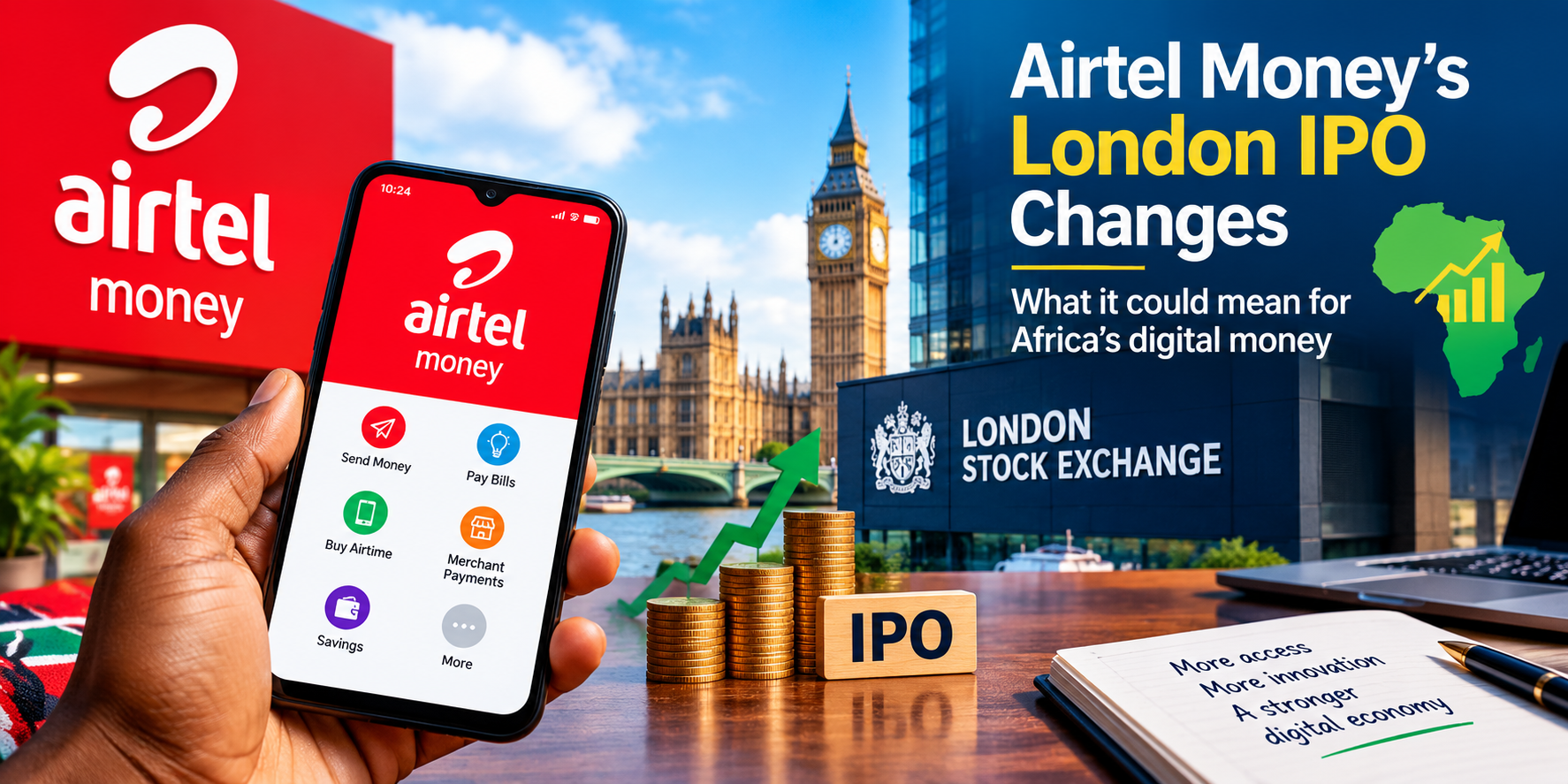
For millions of Africans, sending money, paying bills or buying goods can now happen with a few taps on a phone. But behind those everyday transactions is a rapidly growing financial industry — and Airtel Money is preparing to take that business to another level.
Airtel Money is reportedly preparing for a London stock-market listing, but the company’s IPO plans have changed significantly as it approaches the proposed launch.
According to Reuters, Airtel Money is considering reducing the size of its planned London initial public offering. The mobile-money business is now reportedly seeking to raise at least $800 million, compared with an earlier target of between $1.5 billion and $2 billion. The company has also reportedly lowered its valuation expectations following feedback from investors.
The listing could begin as soon as the week of September 21, although the final date and terms have not yet been confirmed.
Why Is Airtel Money Going Public?
An initial public offering, or IPO, is when a private company or business unit offers shares to public investors through a stock exchange.
For Airtel Money, a London listing would give investors an opportunity to invest directly in its mobile-financial-services business rather than viewing it only as part of Airtel Africa's wider telecommunications operations.
The move also highlights how important mobile money has become in Africa.
People increasingly use mobile wallets for much more than sending money to friends and relatives. Mobile-money platforms can facilitate merchant payments, bill payments, airtime purchases, cash transfers and other financial services.
That makes the sector increasingly important to consumers, businesses and investors.
The $800 Million Question
The reported reduction in the IPO target does not necessarily mean that Airtel Money's business is shrinking.
That distinction matters.
A company can reduce the amount it plans to raise for several reasons. It could offer fewer shares, change the price of the shares or restructure the transaction.
Reuters reported that the change followed investor feedback, but the precise final valuation and structure have not yet been disclosed. Those details will only become clearer when the formal IPO documents and pricing information are released.
Airtel Money's reported target of at least $800 million is therefore not the same thing as saying the company is worth $800 million.
The amount raised depends on how many shares are sold and at what price.
Africa’s Digital Money Economy Is Getting Bigger
The Airtel Money story comes at a time when digital payments are becoming increasingly important across Africa.
Mobile phones have allowed financial services to reach people who may not have traditional bank accounts or easy access to physical bank branches.
For consumers, this can make everyday transactions faster and more convenient.
For small businesses, digital payments can also make it easier to receive money from customers and keep transaction records.
But growth in digital finance also creates new challenges.
Users have to think about transaction charges, fraud, account security, privacy and how much money they keep in digital wallets.
A growing digital-money economy does not automatically mean everyone becomes financially secure.
What Does This Mean for Ordinary Users?
An IPO involving a major mobile-money company may sound like something that only matters to investors in London.
It doesn't.
The growth of mobile money affects ordinary consumers because financial companies increasingly compete to provide payment, savings, credit and other financial products through mobile devices.
That competition can influence the services available to consumers.
But users should avoid assuming that a company's IPO automatically means better financial products or lower costs.
The real impact depends on how the business develops after the listing and how it competes in the markets where it operates.
What Investors Will Be Watching
If Airtel Money proceeds with the London listing, investors will likely pay close attention to several figures.
These include the company's valuation, the number of shares being offered, the price of the shares, revenue growth, profitability, customer numbers and transaction volumes.
Investors will also need to consider risks.
Mobile-money businesses operate in highly regulated financial markets. They also face competition, currency movements, technology costs and changing consumer behaviour.
A rapidly growing customer base is useful, but investors ultimately need to understand whether that growth can translate into sustainable profits.
The Bigger Picture
Airtel Money's proposed IPO is more than a corporate fundraising exercise.
It is another sign of how Africa's financial system is changing.
For years, many financial transactions depended heavily on cash and physical bank branches. Mobile technology has changed that relationship.
Today, a phone can act as a wallet, payment tool and gateway to financial services.
The Airtel Money listing could therefore become an important moment for the African digital-finance industry.
However, the final story will only become clear once the company releases the official IPO details.
For consumers, the lesson is simpler: as digital finance grows, understanding how mobile money works becomes just as important as knowing how to manage cash.
Your phone may be becoming your wallet — but the responsibility to manage that money still belongs to you.
#AirtelMoney #AirtelAfrica #LondonIPO #IPO #MobileMoney #DigitalFinance #Fintech #AfricanFintech #DigitalPayments #Africa #FinancialLiteracy #PersonalFinance #Investing #MoneyManagement #CashlessEconomy #AfricanEconomy #FTLuma #FinanceNews #BusinessNews #FintechAfrica




💬 Discussion (0)
No comments yet. Be the first to share your thoughts!
Leave a Response