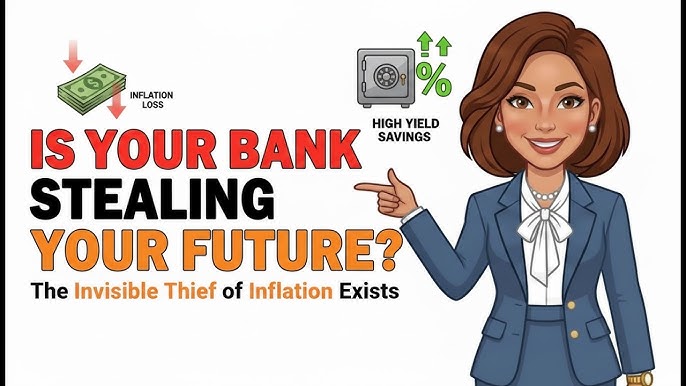
Imagine waking up, opening your banking app, and realizing a tiny thief has been sneaking into your account every single night.
This thief doesn’t steal your password or hack your account. In fact, if you look at your balance, the number looks exactly the same. If you had $5,000 yesterday, you still see $5,000 today.
But out in the real world, something is wrong. When you go to buy groceries, gas, or a movie ticket, you suddenly realize your $5,000 can’t buy as much as it used to. It feels more like $4,000.
This financial villain is real, and its name is Inflation.
People often call inflation the "invisible tax." You will never get a bill for it in the mail, and you don’t pay it on tax day. Yet, it quietly shrinks the value of your money every single day.
If you are letting your extra cash just sit in a basic bank account, you aren't keeping it safe. You are actually letting this villain take away your hard-earned financial superpower. Let’s look at how this happens and how you can stop it.
What Is Inflation, Exactly?
Put simply, inflation is when the prices of almost everything go up over time. When prices go up, your money loses purchasing power. This is just a fancy way of saying your money can't buy as much stuff.
Think of money like a measuring tape. If you want to build a table, you need the inches on your tape measure to stay the same size. But inflation is like a weird glitch that makes the inches on your tape measure get a little bit shorter every year. The table hasn't changed size, but you suddenly need more "inches" of money to cover it.
How Is It Measured?
To see how fast prices are rising, experts track a big, imaginary "shopping basket" of things a normal family buys every month. This includes:
Food: Milk, bread, chicken, and coffee.
Housing: Rent or mortgage payments and electricity.
Fun: TV streaming services, pets, and concert tickets.
Travel: Gas, car insurance, and plane tickets.
When you hear on the news that inflation is at 4%, it means that this big basket of everyday goods costs 4% more than it did exactly one year ago.
Why Keeping All Your Cash in the Bank Is a Trap
For a long time, parents gave their kids simple advice: Work hard, make money, and put it in a savings account to keep it safe.
While that sounds smart, it actually hides a big trap. Today, a basic bank account is one of the worst places to leave your extra money for a long time.
The Illusion of Safety
When you see your savings balance on your phone, your brain feels safe. You think, "Great, my money is still there!"
But you are seeing the face value of the money, not its real value.
Face Value: The exact number on the screen (like $10,000).
Real Value: What that $10,000 can actually buy at the store.
The bank promises to keep your number the same. But inflation destroys what that number can buy.
The Sad Math of Normal Savings Accounts
Most basic bank accounts pay you almost zero interest—often around 0.01%. Let’s look at what happens if you leave $10,000 in a normal bank account for 10 years while inflation is at 4%.
Year 0: You have $10,000. It buys $10,000 worth of stuff.
Year 1: Your bank gives you a tiny bit of interest. You have $10,010. But because prices went up, your money only buys $9,615 worth of stuff.
Year 5: Your bank balance says $10,050. But your buying power has dropped to $8,219.
Year 10: Your balance says $10,100. But in the real world, your money can only buy $6,755 worth of stuff.
You didn't spend the money, and you didn't lose it in a stock market crash. You just let it sit there. Yet, the invisible tax still cost you over $3,200 of real wealth.
Your Shrinking "Superpower."
To understand why this is a big deal, think about what money really is. Money isn't just paper or numbers on a screen. Money is your time and energy.
When you work 40 hours a week, you are trading pieces of your life for cash. That cash is your financial superpower. It gives you the freedom to buy a home, take care of your family, and choose how you want to live.
When you let inflation shrink that money, you are letting it waste the hard work you did in the past.
Is Cash Really "Safe"?
A lot of people think investing in stocks or housing is "too risky," so they stick to cash because it feels safe. But we need to look at risk differently:
Market Risk: The risk that stocks will go up and down. This can be scary in the short term, but historically, the market goes up over a long time.
Inflation Risk: The 100% guarantee that your cash will lose value over time.
Keeping all your money in cash isn't avoiding risk. It is choosing to lose a little bit of your wealth every single day.
Why Does This Invisible Tax Even Exist?
If inflation hurts our savings so much, why don't governments just stop it?
Believe it or not, governments and central banks actually want a little bit of inflation (usually around 2% a year). They do this for two main reasons:
It Keeps the Economy Moving
If prices were dropping every year (which is called deflation), you would stop spending money. Why buy a new car or a laptop today if you know it will be 5% cheaper next year? You would wait. If everyone waits and stops buying things, businesses close down, and people lose their jobs. A little bit of inflation encourages people to buy things and invest today, which keeps the economy healthy.
?
It Helps People (and Governments) with Debt
Inflation makes debt cheaper to pay back. If a government borrows $1 million today, and inflation makes the dollar worth less over the next ten years, that $1 million is much easier to pay back later. Because governments owe a lot of money, inflation actually works in their favor.
How to Fight Back and Defeat the Villain
You can't change the country's economy, but you can change what you do with your money. To protect your financial superpower, you need to step up from being a saver to being an investor.
Your main goal is to make your money grow faster than the rate of inflation. Here is your playbook to beat the invisible tax:
Use a High-Yield Savings Account (HYSA)
What it is: Online banks offer special savings accounts that pay much higher interest than normal banks.
How it helps: If inflation is at 4% and your high-yield account pays you 4.5% interest, your money is actually growing fast enough to beat the villain.
Best for: Your emergency fund (3 to 6 months of living expenses) and money you need to use soon.
Invest in the Stock Market (Index Funds)
What it is: Buying small pieces of hundreds of major companies at once through things called index funds.
How it helps: When things get more expensive, companies raise their prices. This means their profits go up, and the value of their stocks goes up too. Over the long run, the stock market has been one of the best ways to beat inflation.
Best for: Long-term goals, like retirement or money you don't need for at least 5 years.
Real Estate
What it is: Owning physical property, like a house or an apartment.
How it helps: As the cost of living goes up, home values and rents usually go up too. If you rent out a property, you can raise the rent over time to match inflation.
Best for: People who want a physical asset that can bring in monthly income.
Conclusion: Take Back Your Power
Inflation isn't going away. Prices will continue to climb as the years go on.
But now that you know how the invisible tax works, you can protect yourself. Cash is a great tool for emergencies and buying things today, but it is a terrible tool for building long-term wealth.
Once you have enough cash saved for emergencies, don't let the rest of your money sit idly in a basic bank account. Put it to work in high-yield accounts or investments. Take back your financial superpower and make sure your hard work pays off for your future!

💬 Discussion (0)
No comments yet. Be the first to share your thoughts!
Leave a Response