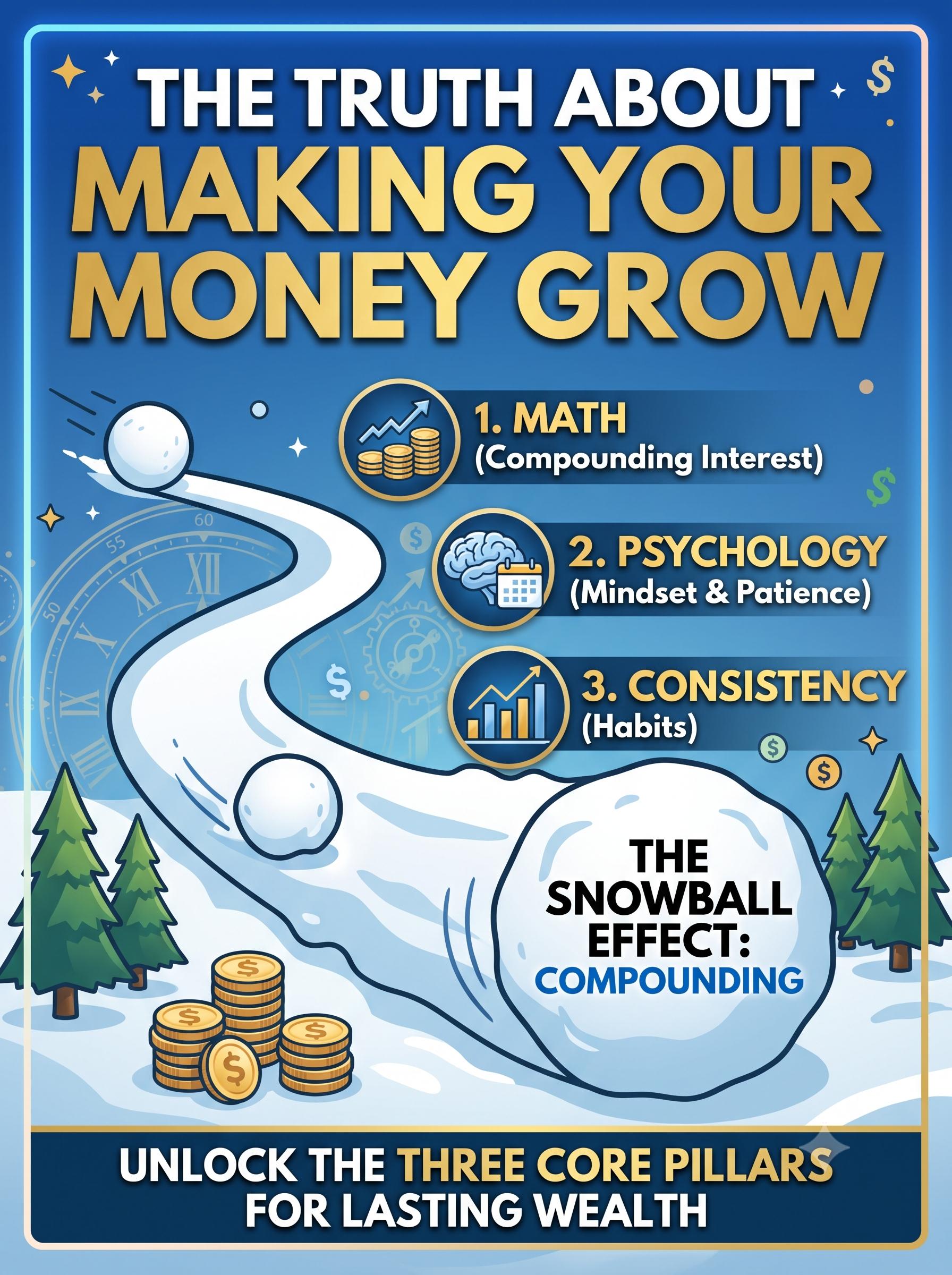
When it comes to turning money into more money, there is a pervasive myth that whispers of secret codes, get-rich-quick shortcuts, and hidden algorithms known only to the wealthy. We see the headlines: “The One Trick to Double Your Savings,” or “How This Teenager Retired in a Week.” But if you look behind the curtain of the most successful investors throughout history, you won’t find magic spells. You will find something far more reliable, albeit significantly less exciting: math, psychology, and consistency.
The Foundation: Math, Psychology, and Consistency
Wealth building is rarely a sprint; it is an ultramarathon. The people who truly amass wealth are not the gamblers who bet everything on a volatile trend. They are the practitioners of the long game. The secret is that there is no secret.
First, there is the math. Compound interest is frequently called the “eighth wonder of the world” by those who understand it and a crushing debt trap by those who don’t. It is the simple, mathematical reality that money, when left alone, can breed more money.
Then, there is the psychology. This is where most people falter. Humans are wired for instant gratification. We want to see our efforts rewarded immediately. When we invest, we want to see the numbers tick up by the end of the week. But patience is the primary engine of wealth. The ability to resist the urge to “tweak” your portfolio or cash out during a dip is a psychological superpower.
Finally, consistency. This is the act of showing up. It is the boring, unglamorous habit of setting aside a portion of your income, month after month, regardless of whether the market is up, down, or sideways.
The Rule of Compounding: The Snowball Effect
Imagine standing at the top of a snow-covered hill. You scoop up a tiny ball of snow—small enough to fit in your palm. It doesn't look like much. In fact, it looks rather insignificant.
But as you roll it down the hill, it starts to gather more snow. Because it is bigger, it picks up even more snow on its next rotation than it did on its first. The surface area increases, and it becomes a massive, unstoppable force. By the time it hits the bottom, it is a giant boulder.
This is the rule of compounding. Your money is the snowball. The interest you earn on your investment becomes part of the principal, and then you earn interest on that interest. Early on, the gains seem negligible. But given enough time, the curve shifts from a gentle slope to a vertical climb.
The compounding effect is a slow burn. It relies entirely on the 'time' variable in the equation. While most people focus on 'rate of return', chasing the highest interest rates, the most critical factor is actually the duration. Starting early is far more important than starting big. If you wait for the 'perfect' time to start investing, you have already lost the most powerful tool in your arsenal: time itself.
Ultimately, building wealth is not about being a financial genius. It is about understanding that small, consistent actions, when powered by time and the math of compounding, lead to extraordinary results. It is the boring path, yes, but it is the only one that truly lasts.

💬 Discussion (0)
No comments yet. Be the first to share your thoughts!
Leave a Response